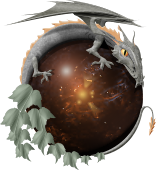
The region under the power of the Dark Lord Morgoth, extending outward and southward from his mighty northern fortress of Angband that lay beneath the Iron Mountains. This land was held in such abhorrence that its name translates into English as 'Land of the Shadow of Dread'. In those parts closest to Angband itself, Dor Daedeloth was marked by sheer cliffs and deep chasms, and the shapes of writhing serpents. In the early years after his return to Middle-earth, Morgoth's power did not yet extend far from his fortress in the North, though in later years the boundaries of his land of darkness would expand.
After the Return of the Noldor to Middle-earth, the Eldar fought off Morgoth's Orcs in the Battle-under-Stars and drove them back to Angband. Fëanor gave chase, but was ambushed as he crossed into Dor Daedeloth and mortally wounded. Later Fëanor's son Maedhros was captured in those borderlands, and after these disasters the Elves held back, watching Dor Daedeloth with a wary eye.
Morgoth launched another attack in I 60, which again the Eldar repulsed in the Glorious Battle, but after this the Elves' watchfulness redoubled. They set the Siege of Angband to hold Morgoth at bay, and that Siege held for nearly four hundred years. During this time Morgoth's land of Dor Daedeloth was confined to the regions immediately surrounding Angband, but that changed in the year I 455, when Morgoth launched the Battle of Sudden Flame that swept away the besieging Elves and Men.
Until this point, the boundaries of Dor Daedeloth had been effectively fixed, but the defences of the Elves were so weakened in the Battle of Sudden Flame that Morgoth was able to extend his power. He soon claimed the forested uplands of Dorthonion and the Pass of Sirion, turning the former into the dark wood of Taur-nu-Fuin and placing the latter under the command of his lieutenant Sauron.
The extension of the borders of Dor Daedeloth after the battle of Dagor Bragollach is explicit,1 but it is less clear whether it grew further in the years that followed. The use of the term falls out of use after this point, but Morgoth's power continued to extend southwards, especially after the Nirnaeth Arnoediad of I 472. If we take Dor Daedeloth as describing all the lands under Morgoth's power - and this does seem to be the intention - then that territory had spread over almost all of Beleriand by the time of the War of Wrath that brought the First Age to an end.
Notes
1 |
Within a list of names from the 1930s (reproduced in Volume V of The History of Middle-earth) Tolkien lists the name of Dor Daedeloth with an earlier spelling 'Dor-deloth, or Dor-no-Daideloth', and says there that, '...its borders were ever increased southward, and early it included Taur-na-Fuin.' (Taur-na-Fuin here is an early spelling of the name usually given in later works as Taur-nu-Fuin.)
|
Indexes:
About this entry:
- Updated 3 August 2026
- This entry is complete
For acknowledgements and references, see the Disclaimer & Bibliography page.
Original content © copyright Mark Fisher 1997-2026. All rights reserved. For conditions of reuse, see the Site FAQ.