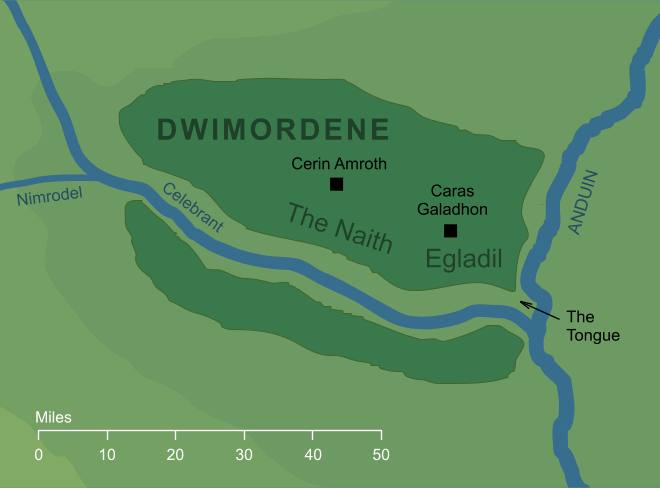
Note that the exact locations of
Cerin Amroth and
Caras Galadhon are not known. The positions shown on this map are speculations based on the text of
The Lord of the Rings.
Note that the exact locations of
Cerin Amroth and
Caras Galadhon are not known. The positions shown on this map are speculations based on the text of
The Lord of the Rings.
The Northmen abandoned Rhovanion and settled in the Vales of Anduin after the Battle of the Plains of III 1856, and they moved on northward to found the land of the Éothéod in III 1977. Within a matter of years from this date, Amroth of Lórien was lost at Sea, and Galadriel took up the rule of Lórien. These events were not directly related to the Northmen at the time, but they must have heard rumours from their former homelands of a mysterious White Lady who now ruled the Elves, and a forest that turned golden in springtime.2 They named the forest Dwimordene in their own tongue, signifying a valley of phantoms.
The Men of the Éothéod dwelt in the far North for some five centuries, until a plea for aid was sent from their ancient allies in Gondor. Their Lord at this time was Eorl the Young, and he chose to answer the call. The Ride of Eorl led him and his horsemen back down the Vales of Anduin, through lands where his people had once lived, until they found themselves approaching a shimmering golden forest, from which a gleaming white mist spread across the Great River. Raised on stories of the mysterious Sorceress of the Golden Wood, Eorl only reluctantly entered the mist, but found that it protected him from the darkness of nearby Dol Guldur. Nonetheless Eorl and his people remained wary of the phantom vale that they called Dwimordene.
Eorl's ride to the aid of Gondor led to the creation of a new realm for his people, which would become known as Rohan. Though the northern borders of this new land lay just a few miles southward of Dwimordene, the Rohirrim shunned it, fearing the nets and webs of deceit (as they imagined it) of the mysterious White Lady of the wood.
These suspicions lasted through the centuries, and even Éomer held them when he first met Aragorn and his companions, though afterward, when the War of the Ring was done, he would meet Galadriel himself. After that War, Galadriel departed from Middle-earth, taking with her the Ring Nenya from which much of her power derived, and the mysterious forces of the vale Dwimordene began to fade into memory.
Notes
1 |
Dwimordene derives from Old English, representing the name of this land in the tongue of the Northmen. It contains dwimor 'phantom, apparition', and dene 'vale' (presumably referring to the valley of the river Silverlode). The combined meaning, 'vale of phantoms', gives some insight into how the Northmen viewed the mysterious beings - from their perspective - who inhabited the Golden Wood. They also used dwimor, without apparent distinction, in the name of the Dwimorberg (or 'Haunted Mountain' beneath which lay the Paths of the Dead) and also for the Ringwraiths (whose Lord was named dwimmerlaik by Éowyn).
|
2 |
The famous Golden Wood of Lórien did not in fact become golden until after the arrival of Galadriel, who planted the first of the golden-leafed mallorn-trees there. Galadriel did not take up her rule in Lórien until a short time after the Northmen had departed from that part of Anduin's vale into the far North, but from later references we can be sure that they knew about the golden trees that grew there after their time.
|
Indexes:
About this entry:
- Updated 8 July 2026
- This entry is complete
For acknowledgements and references, see the Disclaimer & Bibliography page.
Original content © copyright Mark Fisher 1997-2026. All rights reserved. For conditions of reuse, see the Site FAQ.
Website services kindly sponsored by myDISCprofile, the free online personality test.
How do your personal strengths fit in with career matching? How can you identify them? Try a free personality test from myDISCprofile.