The Encyclopedia of Arda - an interactive guide to the world of J.R.R. Tolkien
Dates
Created at the beginning of the Second Age; destroyed in the Downfall of Númenor in II 3319
Location
Running westward from the Inlands of Númenor to flow into the Bay of Eldanna at Eldalondë
Race
Division
Culture
Settlements
Eldalondë stood at the mouth of Nunduinë
Source
In the Mittalmar region of Númenor, some fifty miles westward of the Meneltarma1
Tributaries
None
Outflow
Pronunciation
noondui'neh (ui as in English 'ruin')
Meaning
Probably 'western river'2

Indexes:

About this entry:

  • Updated 7 April 2026
  • This entry is complete

River Nunduinë

The river of Eldalondë

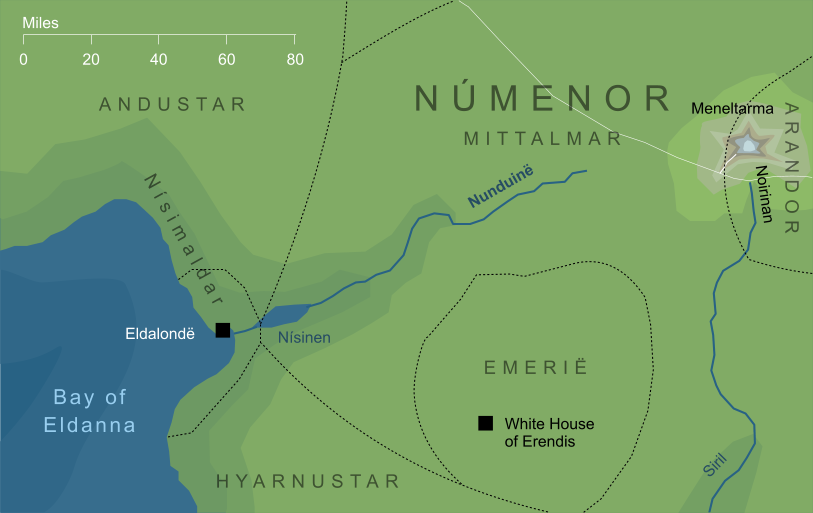
Map of the river Nunduinë

The island of Númenor possessed two significant rivers, both of which sprang from the hills near the feet of the Meneltarma. The larger of the two was Siril, which flowed southward across the Isle, while the second river, Nunduinë, flowed off westward and somewhat southward. Nunduinë ran for a hundred miles or more, mainly through the region of inland plains known as the Mittalmar.

As it approached Númenor's western coasts, the river widened for a stretch of its course to form an elongated lake. All along the banks of this lake grew fragrant plants and flowers, giving the long lake the name Nísinen, the 'fragrant water'. From the western end of this lake, Nunduinë flowed on for a few remaining miles before reaching its mouths on the Bay of Eldanna, the wide western bay of Númenor.

At the mouth of Nunduinë, the Númenóreans established a harbour town, which became known as Eldalondë the 'Elf-haven', because it was to this town that the Elves would often sail in the earlier history of Númenor. These visiting Elves brought gifts of many plants and trees out of the West, which were planted along the coasts on either side of the river's mouth to form the coastal land known as Nísimaldar, the Fragrant Trees.3


Notes

1

At least, our only detailed map of Númenor shows the river rising some distance westward of the mountain. It does seem slightly strange for a river to spring from a flat plain rather than a nearby mountain, and it is possible that the location shown is a matter of cartographical convenience. The prominent label 'Mittalmar' runs directly between the river's source and the mountain, so perhaps the spring was actually in the ridges beneath the mountain, and it shown as it is simply to avoid the line of the river crossing through the 'Mittalmar' label.

2

The -duinë element of this name is definitely 'river', but the initial nun- is less clear. There are rare attested cases in Quenya of nun- being a derivative of numen, 'west', and as the river ran westward through Númenor, an interpretation of something like 'western river' seems appropriate. The Elvish word for 'west' ultimately derived from 'down' (that is, it was the direction of the sunset) so an alternative interpretation might be 'sunset river', though even in this case the association with the west remains relevant.

3

It is hard to avoid making a connection between the Fragrant Trees of Nísimaldar and the fragrant plants that grew along Nunduinë's lake of Nísinen. A natural assumption would be that the trees on the banks of the lake were seeded from those of the coastal land, but if Tolkien intended this, he makes no direct mention of such a relationship.

Indexes:

About this entry:

  • Updated 7 April 2026
  • This entry is complete

For acknowledgements and references, see the Disclaimer & Bibliography page.

Original content © copyright Mark Fisher 2002, 2018-2019, 2026. All rights reserved. For conditions of reuse, see the Site FAQ.

Website services kindly sponsored by Axiom Discovery aptitude and skill testing.
Axiom Discovery gives you comprehensive online aptitude testing covering core skills across a wide range of disciplines.
The Encyclopedia of Arda
Menu
Homepage Search Latest Entries and Updates Random Entry