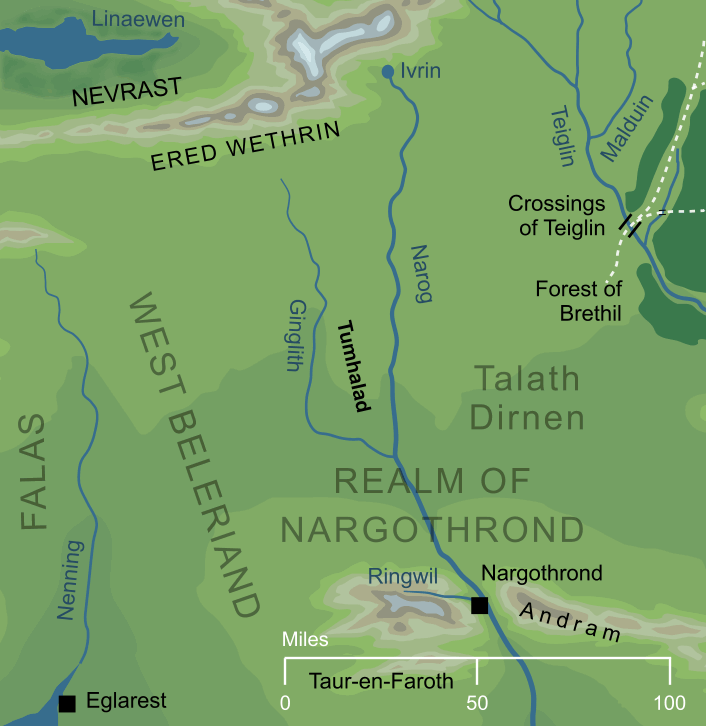
A field in western Beleriand, northward from Finrod's fortress of Nargothrond. It lay between the river Narog and its tributary Ginglith, upriver from the point where the two rivers met. Ginglith and Narog ran parallel for many miles before they reached their confluence, and for this reason Tumhalad was a narrow land that ran down into an angle at its southern end where Ginglith veered eastward to flow into Narog.
Tumhalad was important to history as the place where the armies of Nargothrond made their last stand against the encroaching forces of Morgoth. For centuries, the Elves of Nargothrond had pursued a policy of secrecy and concealment from the Enemy, but when Túrin took effective command of Nargothrond's warriors, he led them openly into battle. Thus Nargothrond's location was revealed, and in I 495 the Dark Lord sent a force led by the Dragon Glaurung to capture the city.
The army of Nargothrond marched out to meet the Dragon and his Orcs at the Battle of Tumhalad, but that battle was a disaster for the Elves. Glaurung had a complete victory, overwhelming the defenders and then carrying on southward to sack their city. Túrin was one of the few survivors, and he hurried back to Nargothrond, where the Dragon beguiled him, so that he could only watch as the last of the people of the city were led away into thraldom.
Tumhalad's location between the rivers Ginglith and Narog is both described in The Silmarillion and shown on the accompanying map, and we follow that location here. However, Christopher Tolkien later came to doubt this as the precise position of the field. In notes in volume XI of The History of Middle-earth, he relates that his father marked 'Tumhalad' in pencil in the location shown, but various textual references imply that Tolkien's placing of the label may not have been intended for that exact location.
In one version of the battle it is specifically stated that Glaurung travelled down Narog's eastern banks, which might be taken to suggest that the place called Tumhalad actually referred to Narog's upper vales, and extended into the lands eastward of the river. On the other hand, the field of Tumhalad is explicitly said to have been '...between Ginglith and Narog' (Quenta Silmarillion 21, Of Túrin Turambar) and the army of Nargothrond was described as being 'penned' there by the enemy (presumably in the angle at the southern end of the field). So, regardless of other considerations, Tumhalad must have at least incorporated the land between the two rivers.
Notes
1 |
The name Tumhalad is not explained. It seems to contain tum 'valley', and also possibly lad, 'plain' or 'field'. We might tentatively interpret it as something like 'field between valleys' (that is, a flat region between the vales of Ginglith and Narog), though it far from clear whether this is the intended meaning.
|
Indexes:
About this entry:
- Updated 7 November 2026
- This entry is complete
For acknowledgements and references, see the Disclaimer & Bibliography page.
Original content © copyright Mark Fisher 1997-2026. All rights reserved. For conditions of reuse, see the Site FAQ.
Website services kindly sponsored by Axiom Discovery aptitude and skill testing.
Personality is one part of understanding a candidate's suitability for a role, but aptitude can also be crucial.
 SHARE